
T
Tyler Durden
Guest
Why The Fertilizer Crisis May Spark Record Inflows Into Agri ETFs
Second- and third-order effects from a three-week - and potentially longer - disruption at the Strait of Hormuz are extending well beyond energy markets.
Even as some vessel transits resume through the narrow waterway, the shipping backlog continues to build across the Gulf region and could take weeks, if not longer, to clear.
At the same time, Qatar's LNG export capacity may take years to fully recover after IRGC drone or missile strikes last week. Notably, natural gas is a key feedstock for nitrogen fertilizer production.
The broader implication is that a food price shock could materialize in the second half of this year as disruptions to energy, shipping, and fertilizer work their way through global supply chains.
Goldman analyst Jasmin Schneider said of this dynamic, "We anticipate that March 2026 will set a new record for agricultural ETF inflows over the next few sessions and overtake March 2022, during the Russian invasion of Ukraine, as the strongest grossing month."
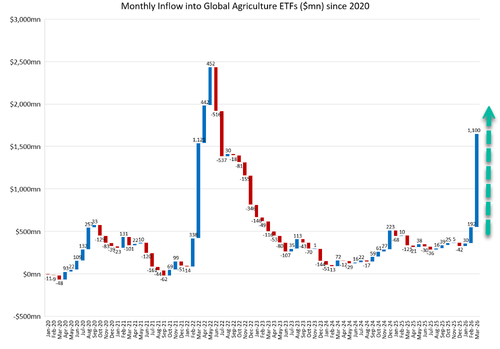
Schneider continued, "Consistent with the other major supply shock of the past six years, the Russian invasion of Ukraine in February 2022, Iran's war has caused violent volatility spikes across oil and energy markets (chart 3)."
She also provided clients with some of the most popular agricultural ETFs to trade:
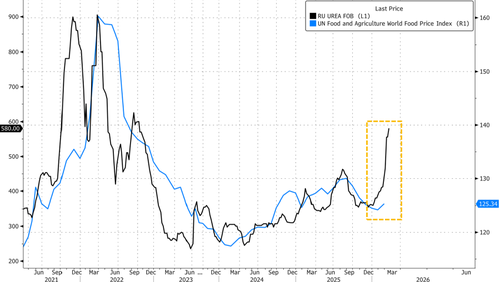
Yesterday, we showed readers the movement in urea fertilizer prices relative to the FAO World Food Index. A spike is incoming.
The Bloomberg Agricultural Subindex has already sharply retraced the 2020-22 run to the 50% Fibonacci level, then spent nearly two years moving sideways.
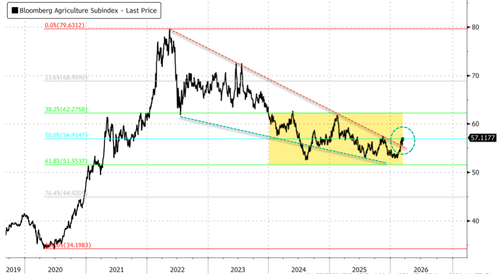
That may suggest a reversal is forming as the energy shock morphs into a fertilizer supply crisis, which could later this year translate into lower crop yields, thus pushing food prices higher.
The conversation grows louder by the day as disruption at the Hormuz chokepoint hits the global nitrogen fertilizer market and, in turn, is set to impact upcoming corn and grain harvests in some key growing regions.
Goldman commodity analysts Lina Thomas and Daan Struyven penned a note on Tuesday warning clients that chokepoint risks in the Strait of Hormuz may affect global agricultural prices.
"The Strait of Hormuz is a critical route in the global nitrogen fertilizer market, which accounts for 60% of global fertilizer use and is especially important for crops like corn and other grains," Thomas and Struyven wrote in the note.
They warned that Hormuz disruptions not only constrain global fertilizer availability, but also that, with seaborne LNG flows from the region limited, any ability to boost fertilizer production elsewhere would be impacted.
"Given fertilizer accounts for ~20% of grain costs, the largest potential boost to grain prices is more likely to come from reduced grain supply. Fertilizer disruptions may reduce grain production both through yield losses from delayed or sub-optimal nitrogen application and potential acreage shifts toward less fertilizer-intensive crops," the analysts said.
They noted that the US is viewed as "currently relatively insulated because the conflict began just ahead of the planting season," adding that the most exposed areas include Europe, Australia, and the Southern Hemisphere, where crop calendars are later.
Even though US farmers may be relatively insulated, that does not mean US crop prices will remain low, as analysts expect global crop prices to rise.
Also on Tuesday, Russia suspended ammonium nitrate exports from March 21 through April 21 to secure domestic fertilizer supplies during the spring planting season. The report was released by Russia's state-run news agency TASS, citing the Agriculture Ministry.
Last week, former central bank adviser Alexandra Prokopenko put a timeline on when the food price shock could appear in global markets, saying she believes it could emerge in six to nine months.
Latest on fertilizer and food supply chain amid Hormuz chokepoint:
Bloomberg macro strategist Simon White recently noted that the energy and fertilizer supply shock is "troublesome for second-round inflationary effects."
Professional subscribers can read the full Goldman report here at our new Marketdesk.ai portal
Tyler Durden Wed, 03/25/2026 - 15:22
Continue reading...
Goldman Now Anticipates Record Inflows For AGRI ETFs
Second- and third-order effects from a three-week - and potentially longer - disruption at the Strait of Hormuz are extending well beyond energy markets.
Even as some vessel transits resume through the narrow waterway, the shipping backlog continues to build across the Gulf region and could take weeks, if not longer, to clear.
At the same time, Qatar's LNG export capacity may take years to fully recover after IRGC drone or missile strikes last week. Notably, natural gas is a key feedstock for nitrogen fertilizer production.
The broader implication is that a food price shock could materialize in the second half of this year as disruptions to energy, shipping, and fertilizer work their way through global supply chains.
Goldman analyst Jasmin Schneider said of this dynamic, "We anticipate that March 2026 will set a new record for agricultural ETF inflows over the next few sessions and overtake March 2022, during the Russian invasion of Ukraine, as the strongest grossing month."
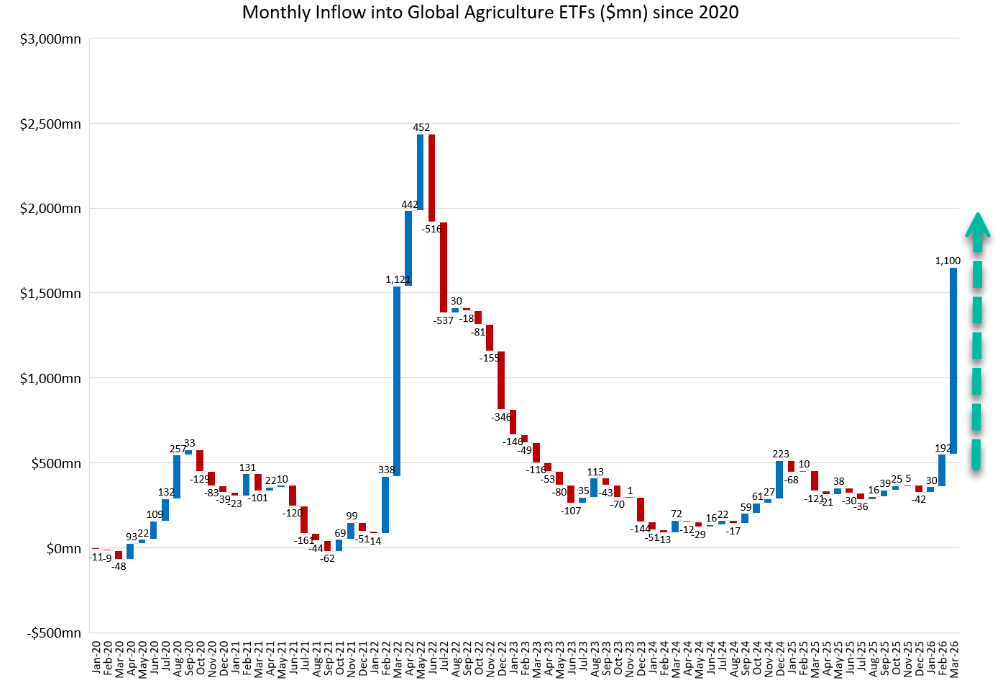
Schneider continued, "Consistent with the other major supply shock of the past six years, the Russian invasion of Ukraine in February 2022, Iran's war has caused violent volatility spikes across oil and energy markets (chart 3)."
She also provided clients with some of the most popular agricultural ETFs to trade:
AIGA LN: WisdomTree Agriculture. Broad agriculture basket exposure.
AIGG LN: WisdomTree Grains. Grain basket exposure.
WEAT LN: WisdomTree Wheat. Single-commodity wheat exposure.
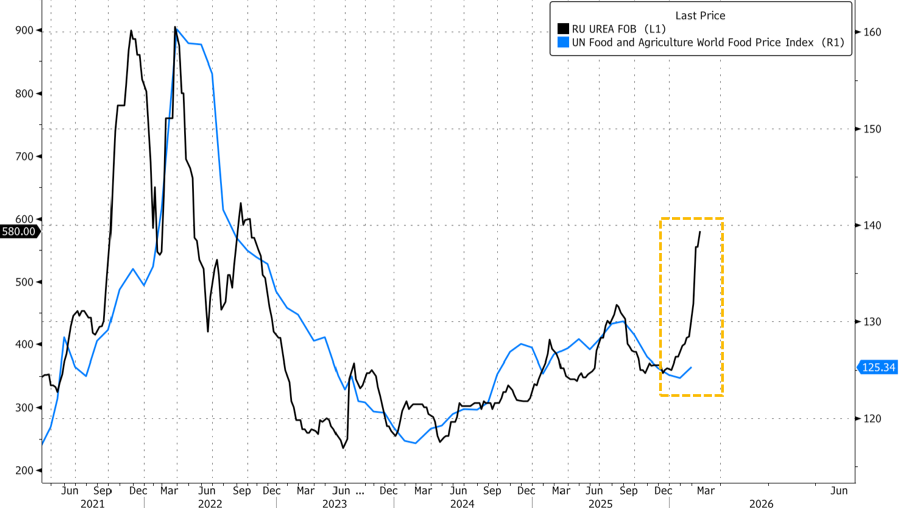
Yesterday, we showed readers the movement in urea fertilizer prices relative to the FAO World Food Index. A spike is incoming.
The Bloomberg Agricultural Subindex has already sharply retraced the 2020-22 run to the 50% Fibonacci level, then spent nearly two years moving sideways.
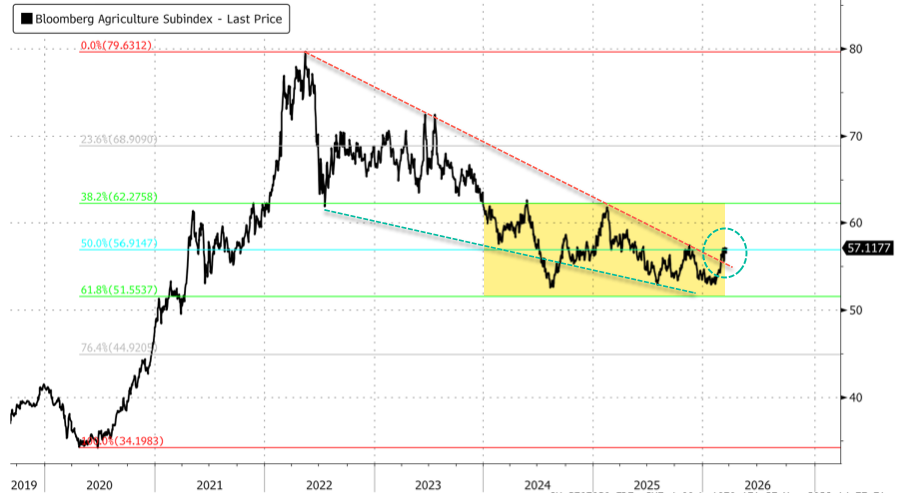
That may suggest a reversal is forming as the energy shock morphs into a fertilizer supply crisis, which could later this year translate into lower crop yields, thus pushing food prices higher.
Goldman Warns About Incoming Food Price Spike
The conversation grows louder by the day as disruption at the Hormuz chokepoint hits the global nitrogen fertilizer market and, in turn, is set to impact upcoming corn and grain harvests in some key growing regions.
Goldman commodity analysts Lina Thomas and Daan Struyven penned a note on Tuesday warning clients that chokepoint risks in the Strait of Hormuz may affect global agricultural prices.
"The Strait of Hormuz is a critical route in the global nitrogen fertilizer market, which accounts for 60% of global fertilizer use and is especially important for crops like corn and other grains," Thomas and Struyven wrote in the note.
They warned that Hormuz disruptions not only constrain global fertilizer availability, but also that, with seaborne LNG flows from the region limited, any ability to boost fertilizer production elsewhere would be impacted.
"Given fertilizer accounts for ~20% of grain costs, the largest potential boost to grain prices is more likely to come from reduced grain supply. Fertilizer disruptions may reduce grain production both through yield losses from delayed or sub-optimal nitrogen application and potential acreage shifts toward less fertilizer-intensive crops," the analysts said.
They noted that the US is viewed as "currently relatively insulated because the conflict began just ahead of the planting season," adding that the most exposed areas include Europe, Australia, and the Southern Hemisphere, where crop calendars are later.
Even though US farmers may be relatively insulated, that does not mean US crop prices will remain low, as analysts expect global crop prices to rise.
Also on Tuesday, Russia suspended ammonium nitrate exports from March 21 through April 21 to secure domestic fertilizer supplies during the spring planting season. The report was released by Russia's state-run news agency TASS, citing the Agriculture Ministry.
Last week, former central bank adviser Alexandra Prokopenko put a timeline on when the food price shock could appear in global markets, saying she believes it could emerge in six to nine months.
Latest on fertilizer and food supply chain amid Hormuz chokepoint:
Russia Halts Ammonium Nitrate Exports As Global Fertilizer Crisis Set To Worsen
Countdown Begins: Former Central Bank Advisor Warns Food-Price Shock Could Hit "Within 6 To 9 Months"
Glitch Shuts Australia's Biggest Maker Of Vital Fertilizer Input For 2 Months At Worst Possible Time
Trump Admin Seeks Alternative Fertilizer Supplieshttps://www.zerohedge.com/commodities/trump-administration-seeks-alternative-fertilizer-supplies
Bloomberg macro strategist Simon White recently noted that the energy and fertilizer supply shock is "troublesome for second-round inflationary effects."
Professional subscribers can read the full Goldman report here at our new Marketdesk.ai portal
Tyler Durden Wed, 03/25/2026 - 15:22
Continue reading...