
T
Tyler Durden
Guest
Russia Think Tank Tells Chinese Media That U.S. Endgame In Iran Is To "Achieve Market Monopoly" In Logistics, Energy
Russian military blogger Mikhail Zvinchuk, the operator behind the Rybar Telegram channel, recently surfaced in an interview with the Chinese outlet Guancha, offering a non-Western assessment of the ten-week U.S.-Iran war.
The interview is notable given that Washington has targeted the private Russian think tank, with the State Department's Rewards for Justice program offering up to $10 million for information related to Rybar-linked foreign election interference operations.
The main topic of the hour-long conversation between Zvinchuk and the host representing Guancha was the Iranian conflict.
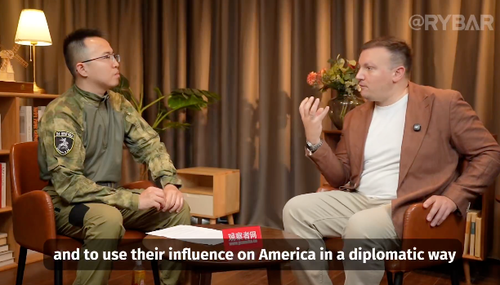
"The main goal of Trump is to shake up the market. Because if you monitor all logistics companies, oil companies, and LNG companies, you will find that big players have started to consume mid-tier and small players."
He continued, "For example, Maersk, one of the biggest logistics companies in the world, can wait for just one or two months and suffer financial losses. But some smaller companies from Greece simply can't withstand such pressure."
Zvinchuk noted, "And it helps this conflict monopolize the market. So Iran is just a mere tool to achieve market monopolization. Because you know quite well that Trump's policy relies on profit. He is a businessman or merchant, so he acts in his and his team's financial interests. And if you place your financial interest above political reputation and above your nation, then your actions have to have economic roots."
In other words, Zvinchuk is claiming that the US-Iranian conflict is not just about Iran or the nuclear threat, but about forcing a market shakeout in the energy and logistics space. The war has clearly disrupted shipping, snarled global supply chains, and already begun to rewire energy flows.
The market shakeout Zvinchuk refers to, especially in the energy sector, has affected Gulf countries such as Qatar, which have seen energy flows dramatically reduced or halted by the conflict. The direct result, as we mentioned earlier in the conflict, is that the US has become a direct beneficiary:
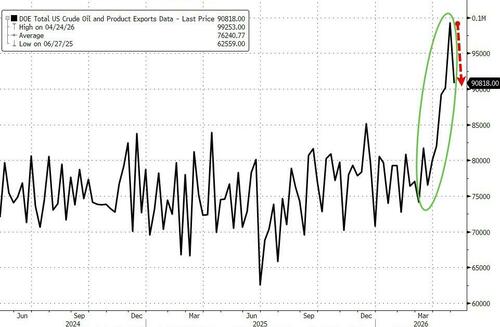
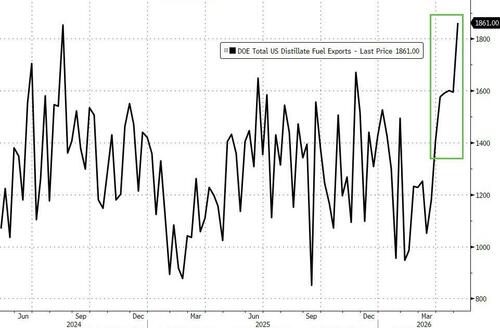
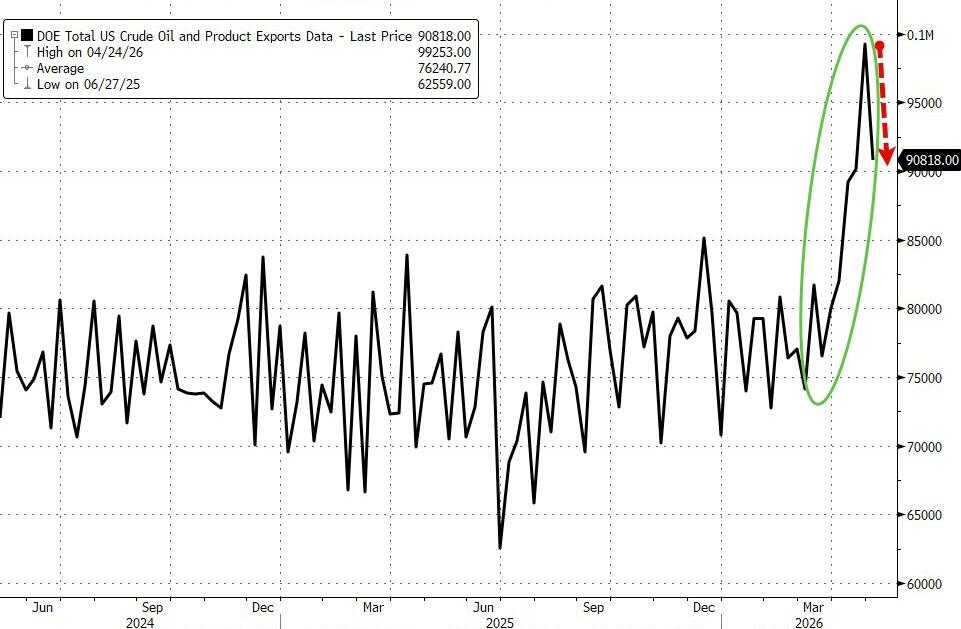
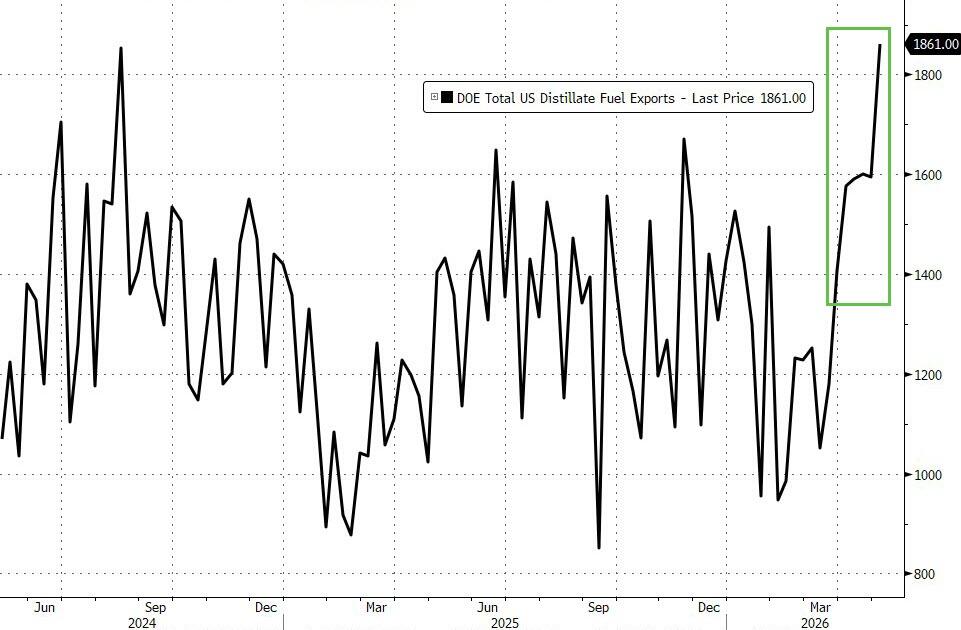
In fact, last week's U.S. Department of Energy report showed U.S. fuel exports hitting record highs, with exports from the Gulf of America becoming the world's emergency gas station...
US Crude Oil Exports
US Diesel Exports
Other topics were discussed during the hour-long interview between Zvinchuk and the Guancha host, but what captured our attention was how the U.S.-Iran war was being framed through an economic lens rather than the security aspect of nuclear threats.
Western audiences are saturated with official White House messaging, selective corporate media leaks, and domestic propaganda, but it is occasionally useful to examine foreign propaganda as well to help understand how adversarial and non-aligned actors interpret Washington's goals in the Middle East through an economic lens.
In our view, the conflict is ultimately about empire, control of maritime chokepoints, and securing global energy supply chains ahead of the 2030s.
Zoltan Pozsar of advisory firm Ex Uno Plures recently explained it best: the Trump administration is "methodically building a portfolio of assets" to pressure China, centered on strategic energy supply nodes and maritime chokepoints that have historically supported Beijing's cheap crude imports.
Tyler Durden Tue, 05/12/2026 - 23:00
Continue reading...
Russian military blogger Mikhail Zvinchuk, the operator behind the Rybar Telegram channel, recently surfaced in an interview with the Chinese outlet Guancha, offering a non-Western assessment of the ten-week U.S.-Iran war.
The interview is notable given that Washington has targeted the private Russian think tank, with the State Department's Rewards for Justice program offering up to $10 million for information related to Rybar-linked foreign election interference operations.
The main topic of the hour-long conversation between Zvinchuk and the host representing Guancha was the Iranian conflict.
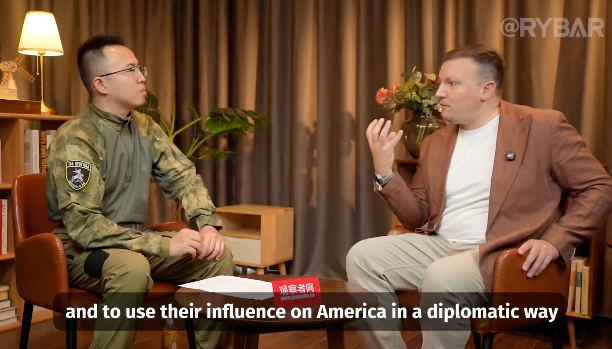
"The main goal of Trump is to shake up the market. Because if you monitor all logistics companies, oil companies, and LNG companies, you will find that big players have started to consume mid-tier and small players."
He continued, "For example, Maersk, one of the biggest logistics companies in the world, can wait for just one or two months and suffer financial losses. But some smaller companies from Greece simply can't withstand such pressure."
Zvinchuk noted, "And it helps this conflict monopolize the market. So Iran is just a mere tool to achieve market monopolization. Because you know quite well that Trump's policy relies on profit. He is a businessman or merchant, so he acts in his and his team's financial interests. And if you place your financial interest above political reputation and above your nation, then your actions have to have economic roots."
In other words, Zvinchuk is claiming that the US-Iranian conflict is not just about Iran or the nuclear threat, but about forcing a market shakeout in the energy and logistics space. The war has clearly disrupted shipping, snarled global supply chains, and already begun to rewire energy flows.
The market shakeout Zvinchuk refers to, especially in the energy sector, has affected Gulf countries such as Qatar, which have seen energy flows dramatically reduced or halted by the conflict. The direct result, as we mentioned earlier in the conflict, is that the US has become a direct beneficiary:
US LNG Export Terminals "Running Near Maximum" As MidEast Energy Infra Descends Into Chaos
Qatar Dethroned As 'LNG King' As U.S. Seizes Throne, Reshaping Future Of Gas
Fill 'er Up: Record Armada Of Tankers Bound For US Gulf To Load Oil
In fact, last week's U.S. Department of Energy report showed U.S. fuel exports hitting record highs, with exports from the Gulf of America becoming the world's emergency gas station...
US Crude Oil Exports
US Diesel Exports
Other topics were discussed during the hour-long interview between Zvinchuk and the Guancha host, but what captured our attention was how the U.S.-Iran war was being framed through an economic lens rather than the security aspect of nuclear threats.
Western audiences are saturated with official White House messaging, selective corporate media leaks, and domestic propaganda, but it is occasionally useful to examine foreign propaganda as well to help understand how adversarial and non-aligned actors interpret Washington's goals in the Middle East through an economic lens.
In our view, the conflict is ultimately about empire, control of maritime chokepoints, and securing global energy supply chains ahead of the 2030s.
Zoltan Pozsar of advisory firm Ex Uno Plures recently explained it best: the Trump administration is "methodically building a portfolio of assets" to pressure China, centered on strategic energy supply nodes and maritime chokepoints that have historically supported Beijing's cheap crude imports.
Tyler Durden Tue, 05/12/2026 - 23:00
Continue reading...