
T
Tyler Durden
Guest
The Overhyped Nuclear Hazard America Has Mastered
Nuclear waste remains one of the most misunderstood aspects of modern energy production in the United States. Critics continue to portray it as a dangerous, unsolvable problem, yet the country has managed it safely and effectively for decades with an impeccable safety record.
Spent fuel from commercial reactors sits securely in pools and dry casks at more than 70 sites across 35 states. Transportation casks have traveled millions of miles without any releases. Not that there was ever a concern for one of these casks breaking open, considering their testing involves being dropped from helicopters and struck by a rocket-propelled locomotive...
France reprocesses the vast majority of its used fuel, demonstrating viable technology at commercial scale. In the United States, no significant radiation releases have occurred from commercial nuclear waste storage or handling in over half a century.
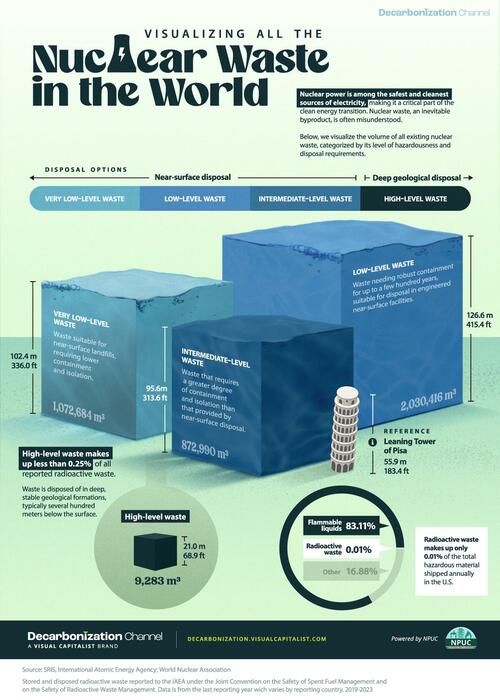
We previously covered Visual Capitalist's depiction of nuclear waste around the world and how the most dangerous waste represents less than a quarter of one percent of the total nuclear waste.
A recent Utility Dive article highlights shifting approaches to this issue and examines the Department of Energy’s proposal for “Nuclear Lifecycle Innovation Campuses.” These facilities would manage the entire nuclear fuel cycle, including reprocessing or recycling of the nation’s approximately 95,000 metric tons of spent fuel, which increases by roughly 2,000 tons each year.
The campuses aim to combine waste management with regional economic benefits, creating long-term jobs and revenue streams for host states. Interest has already emerged from several states, including Utah, South Carolina, Tennessee, Washington, Idaho, and Nebraska.
U.S. taxpayers currently bear the costs for waste management and legacy cleanup. The DOE’s Environmental Management program operates with an annual budget exceeding $8 billion, while the federal government’s liability for permanent disposal now stands at more than $56 billion. The Trump administration also recently asked for an expansion of the funding.
Yet this material increasingly looks like a valuable resource rather than solely a liability. Private companies are beginning to compete aggressively for access to spent nuclear fuel. The DOE recently awarded over $19 million to firms including Oklo, Curio Solutions, Flibe Energy, and SHINE Technologies to advance recycling, transmutation, and isotope-harvesting technologies.
Startups view the material as a feedstock for new reactor fuel, medical isotopes, and industrial applications rather than waste. As demand grows for high-assay low-enriched uranium (HALEU) and specialized isotopes, competition for this resource is expected to intensify.
Nuclear waste is incredibly hazardous, if mishandled. But, America has not mishandled it. With private-sector innovation now treating spent fuel as a strategic asset, the longstanding “problem” is transforming into an economic opportunity.
Tyler Durden Wed, 05/13/2026 - 06:55
Continue reading...
Nuclear waste remains one of the most misunderstood aspects of modern energy production in the United States. Critics continue to portray it as a dangerous, unsolvable problem, yet the country has managed it safely and effectively for decades with an impeccable safety record.
Spent fuel from commercial reactors sits securely in pools and dry casks at more than 70 sites across 35 states. Transportation casks have traveled millions of miles without any releases. Not that there was ever a concern for one of these casks breaking open, considering their testing involves being dropped from helicopters and struck by a rocket-propelled locomotive...
Nuclear waste shipping casks have been through a hell of a lot of testing. Now with Red Alert music. pic.twitter.com/D28AgF9Zgp
— Nick Touran (@whatisnuclear) January 17, 2026
France reprocesses the vast majority of its used fuel, demonstrating viable technology at commercial scale. In the United States, no significant radiation releases have occurred from commercial nuclear waste storage or handling in over half a century.
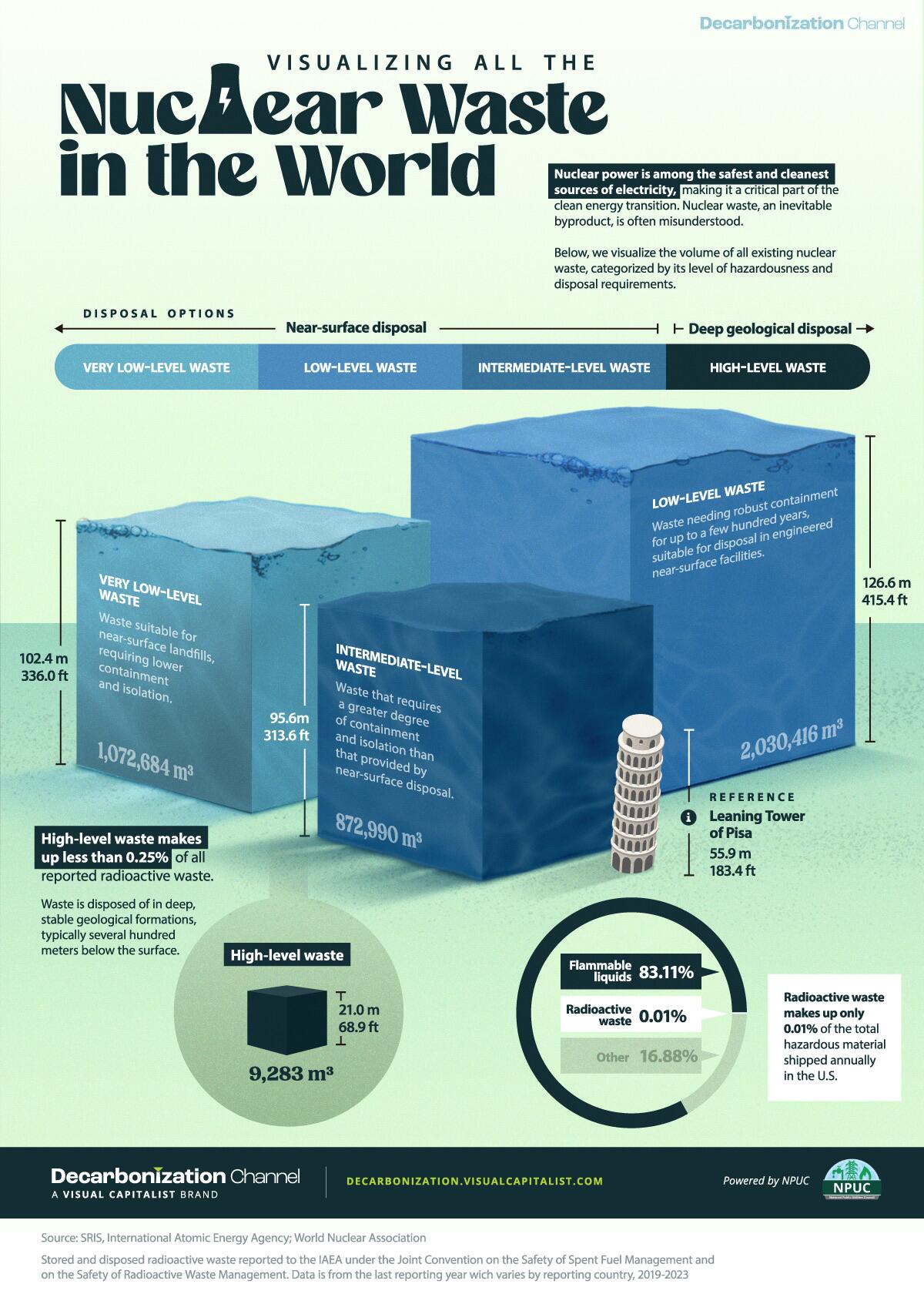
We previously covered Visual Capitalist's depiction of nuclear waste around the world and how the most dangerous waste represents less than a quarter of one percent of the total nuclear waste.
A recent Utility Dive article highlights shifting approaches to this issue and examines the Department of Energy’s proposal for “Nuclear Lifecycle Innovation Campuses.” These facilities would manage the entire nuclear fuel cycle, including reprocessing or recycling of the nation’s approximately 95,000 metric tons of spent fuel, which increases by roughly 2,000 tons each year.
The campuses aim to combine waste management with regional economic benefits, creating long-term jobs and revenue streams for host states. Interest has already emerged from several states, including Utah, South Carolina, Tennessee, Washington, Idaho, and Nebraska.
TN is the global epicenter of nuclear energy, & we're grateful for a new opportunity to lead the nation with a proposal to locate a @ENERGY Nuclear Lifecycle Innovation Campus in Oak Ridge.
Link: https://t.co/019O2Hu3Sc pic.twitter.com/26NfsQahP4
— Gov. Bill Lee (@GovBillLee) April 2, 2026
U.S. taxpayers currently bear the costs for waste management and legacy cleanup. The DOE’s Environmental Management program operates with an annual budget exceeding $8 billion, while the federal government’s liability for permanent disposal now stands at more than $56 billion. The Trump administration also recently asked for an expansion of the funding.
Yet this material increasingly looks like a valuable resource rather than solely a liability. Private companies are beginning to compete aggressively for access to spent nuclear fuel. The DOE recently awarded over $19 million to firms including Oklo, Curio Solutions, Flibe Energy, and SHINE Technologies to advance recycling, transmutation, and isotope-harvesting technologies.
Startups view the material as a feedstock for new reactor fuel, medical isotopes, and industrial applications rather than waste. As demand grows for high-assay low-enriched uranium (HALEU) and specialized isotopes, competition for this resource is expected to intensify.
Nuclear waste is incredibly hazardous, if mishandled. But, America has not mishandled it. With private-sector innovation now treating spent fuel as a strategic asset, the longstanding “problem” is transforming into an economic opportunity.
Tyler Durden Wed, 05/13/2026 - 06:55
Continue reading...